





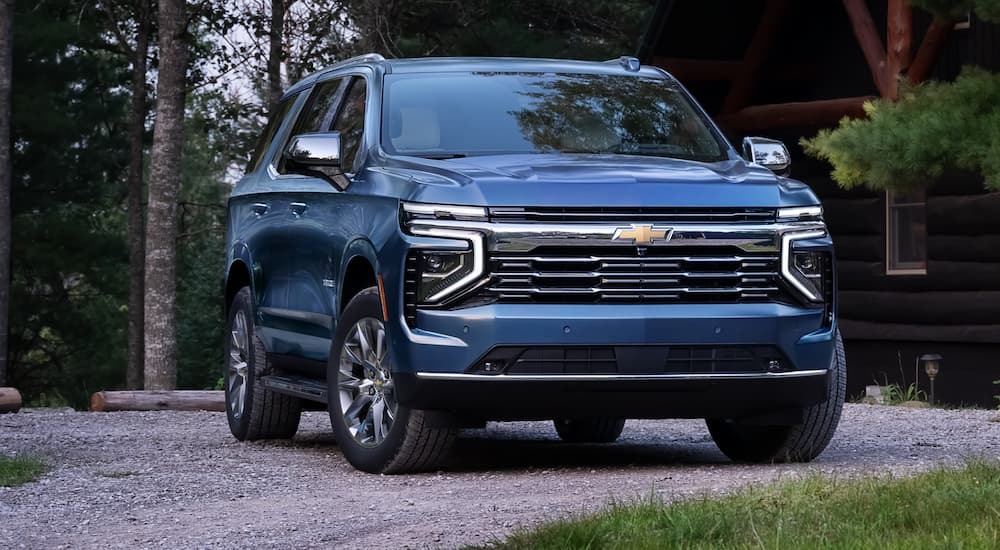
Chevy’s second-largest SUV isn’t afraid to put in a little hard work. While the Tahoe might have earned a reputation as a safe, reliable family vehicle, its potent powertrains, heavy-duty design, and competitive cargo capacity also make it one of the segment’s best offerings when it comes to towing and hauling. The unibody construction technique that’s come to dominate much of the SUV segment might offer some advantages in terms of comfort and efficiency, but these crossover models aren’t designed for the rough and tumble life of a true towing rig. The full-size Tahoe breaks the mold with a traditional body-on-frame design that maximizes its durability, off-road resume, and towing credentials.
This work-ready ride is sure to satisfy a wide range of drivers, from tech-savvy buyers who expect all of the latest comfort and safety tech to off-road enthusiasts, busy families, and those who appreciate a premium driving experience. Still, it’s the SUV’s towing prowess that really has so many buyers considering a Chevy Tahoe for sale. Join us as we review some of the Tahoe’s key performance highlights, including its towing and payload capacities, put those numbers into context, and see how the industrious Chevy fares against some of the industry’s other full and midsize trucks and SUVs.
Three Engines, Endless Possibilities
A full-size SUV deserves a full-size engine, and the Tahoe doesn’t disappoint with a pair of muscular V8 options. The standard SUV is equipped with a 5.3L EcoTec3 engine that’ll never leave drivers wanting for power, producing 355 hp and 383 lb-ft of torque. In fact, the Chevy’s base engine is the brawniest of the bunch, with a maximum towing capacity of 8,400 lbs. That’s a refreshing change of pace in a market where the most tow-ready engines are often limited to upper trims and optional add-ons, and it easily makes the Tahoe one of the best values in the segment. Chevy has always enjoyed a strong following amongst those who prioritize performance, and the impressive entry-level engine speaks to that legacy. The 5.3L engine also leads the way in terms of payload with a maximum capacity of 1,834 lbs, though the 6.2L V8 and 3.0L turbo-diesel I-6 don’t lag too far behind at 1,671 lbs and 1,717 lbs, respectively.
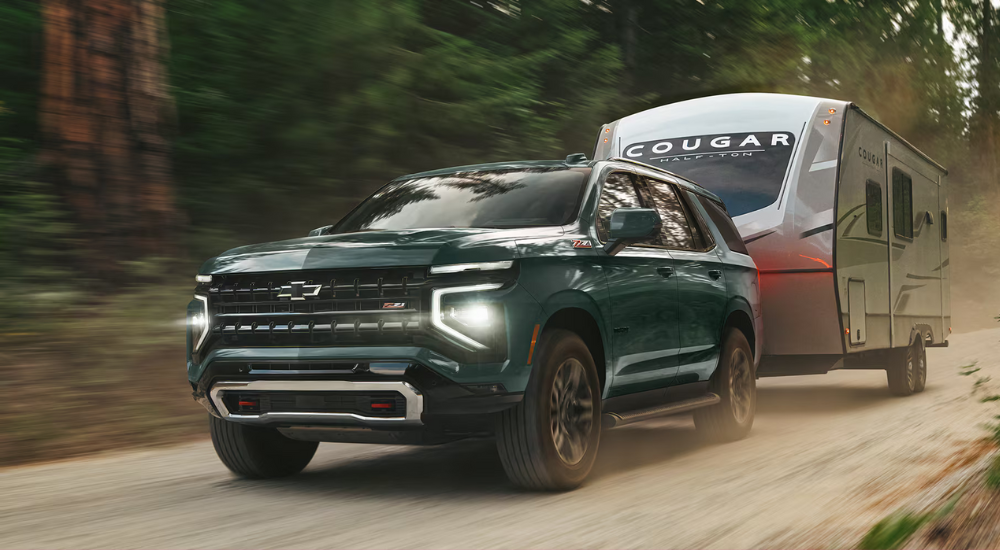
Standard on the High Country trim and available on the Z71, RST, and Premier, the Tahoe’s 6.2L V8 significantly ups the SUV’s output with 433 hp and 467 lb-ft of torque. Both V8 engines are paired with a ten-speed automatic transmission, and though 4WD is available across the entire lineup, most trims default to the RWD approach. The larger EcoTec3 engine trades on its high-performance potential with the ability to sprint from zero to 60 mph in just 5.8 seconds, which is almost a full second faster than the 5.3L version. While it’ll definitely get your blood pumping, the 6.2L engine can’t quite match the base model’s towing capacity, but it doesn’t lag too far behind at 8,200 lbs.
Finally, there’s the Duramax turbo-diesel. Low-end power is the name of the game when it comes to this torque-rich engine, which can pump out 495 lb-ft of raw twisting force along with 305 hp. The turbo-diesel engine is available on all but the base LT trim and represents an enticing upgrade for those who want to enjoy ample towing and payload capacity while also reducing their monthly fuel costs. The diesel engine is a model of efficiency, offering up to 26 MPG on the highway in its RWD format and 24 MPG on the highway for the 4WD model. That’s a significant improvement over the two V8 engines, which both average 20 MPG on the highway. The diesel’s towing capacity of 8,200 lbs can’t quite match the 5.3L, but its heavy-duty design can offer some significant benefits in the long run. While the typical gas engine is lucky to hit 200,000 or 300,000 miles on the odometer, it’s not unusual for a diesel to travel some 500,000 miles before retirement.
A Titan of Towing
How does the Tahoe stack up against some of its full-size rivals when comparing maximum towing capacity? Chevy’s largest SUV, the Suburban, logs a solid third-place finish with a capacity of 8,200 lbs. The Tahoe finishes neck and neck with the GMC Yukon, which isn’t that surprising when you consider that the two SUVs share the same platform, engines, and many mechanical components. The Nissan Armada and Infiniti QX80 represent the Tahoe’s closest competition with their 8,500-lb towing capacities, but Cadillac’s full-size model simply can’t keep pace with the Escalade, topping out at 8,100 lbs.
It’s a strong showing for the Chevy Tahoe, and the SUV only becomes a more tempting option when measured against the midsize segment. Unlike most full-size models, midsize SUVs usually opt for a unibody design. Pulling a heavy load or testing the limits of a vehicle’s payload capacity can really do a number on a vehicle’s frame, and while body-on-frame models were designed to withstand the intense twisting forces that come with such tasks, the same can’t be said for crossovers. Today’s midsize SUVs boast an average towing capacity of just under 5,000 lbs, which is some 40 percent lower than the Tahoe. While the Dodge Durango represents a notable exception, the full-size Chevy easily tops every other midsize SUV when it comes to towing power.
Of course, comparing a body-on-frame SUV to a crossover model isn’t exactly playing fair, but the Tahoe also manages to surpass many of the body-on-frame models that populate the midsize pickup segment. The Chevy Colorado and GMC Canyon lead the traditional midsize segment with a maximum towing capacity of 7,700 lbs, and are joined by Jeep’s lone pickup in the Gladiator. The Ford Ranger trails behind at 7,500 lbs, and the Nissan Frontier finishes a distant fourth with 7,150 lbs of max towing. The Honda Ridgeline brings up the rear at 5,000 lbs, which, while uncompetitive, can largely be credited to its status as the segment’s lone unibody model.
Plenty of Payload and Cargo Space
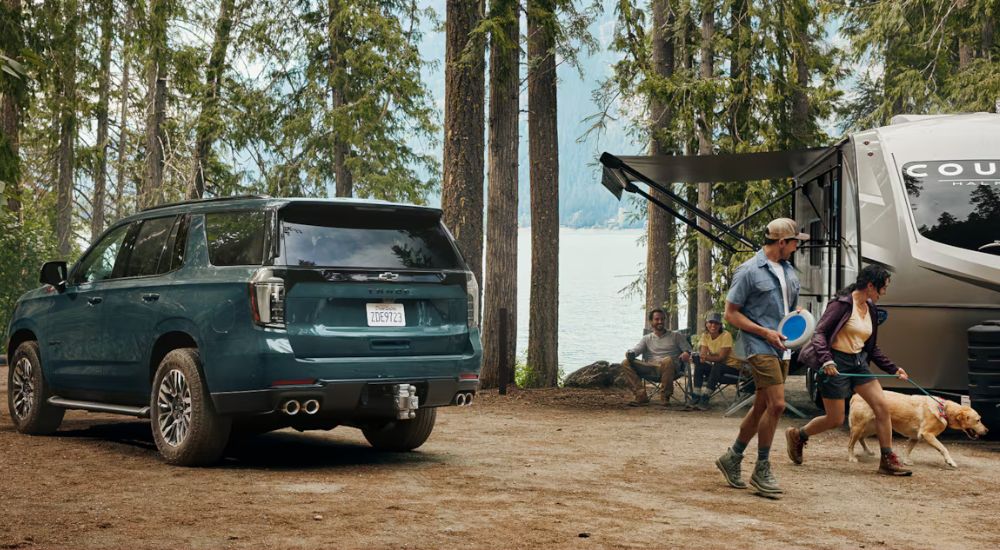
Towing is an important statistic if you’re looking to leverage the Tahoe’s power to pull a boat, camper, or a fully-loaded utility trailer, but it’s not the only metric to consider when comparing full-size SUVs. Payload capacity determines how much weight a vehicle can accommodate inside the vehicle itself, and it’s especially relevant when you’re talking about an expansive SUV like the Chevy Tahoe. The SUV’s eight-passenger capacity and generous storage are two of its biggest selling points, but those generous dimensions can also make it all too easy to test the limits of a vehicle’s payload capacity. Luckily, the full-size Tahoe actually leads the segment with 1,834 lbs of max payload when equipped with the base V8 engine and RWD, which gives it a marked advantage in the competitive category. The GMC Yukon snags the silver medal with 1,792 lbs, while the Ford Expedition trails just behind at 1,758 lbs, and the Toyota Sequoia finishes in fourth at 1,730 lbs. The Jeep Wagoneer places a disappointing fifth and might not be the best option in terms of payload, with a limit of just 1,550 lbs.
Speaking of space, the Tahoe has it in spades with 122.7 cu.ft. of cargo room. Chevy’s full-size Suburban leads the segment with 144.7 cu.ft., but the Tahoe finishes in the top three, with the platform-mate GMC Yukon barely edging the Tahoe in second at 122.8 cu.ft. The Infiniti QX80 clocks in at 101.0 cu.ft., but the rest of the full-size class fails to even break the 100 cu.ft. mark. From your weekly grocery haul and the kid’s sports equipment to camping supplies, luggage, and even large household appliances, the Tahoe can accommodate all the cargo you’ll need to get through the week.
The SUV’s storage capacity is worth writing home about, but it’s the way that Chevy has utilized the space that really sets the Tahoe apart from the typical model. The second-row seats can be easily adjusted to slide forward and backward within the cabin, allowing drivers to increase the SUV’s cargo capacity or give third-row riders a little extra legroom. A large cubby located beneath the central armrest in the front row is ideal for securely storing valuables, and a power rear liftgate enables owners to easily access the cargo area with the touch of a button.
How has Chevy managed to maximize the Tahoe’s cargo space? The SUV’s independent rear suspension (IRS) plays an important role. The decision to swap out the rear axle in favor of the IRS not only upped the Tahoe’s handling and ride comfort, but it also helped to create a lower, flatter cargo floor thanks to the fact that there were fewer suspension components to work around. It’s another example of Chevy doubling down on some of the Tahoe’s strengths while simultaneously addressing some key areas where the SUV’s previous iterations fell short.
Experience the Tahoe’s Potential at Lupient Chevrolet
While the Tahoe’s raw towing and payload numbers are certainly impressive, they do lack a little context. That said, it’s easy to put the SUV’s performance into real-world terms with a few simple examples. Choosing the Chevy Tahoe will allow drivers to pull everything from midsize campers and boats to utility and livestock trailers. Do you want to explore nature atop your favorite equine adventure partner? The Tahoe can easily tow a typical two-horse trailer. Are you looking to elevate your outdoor experience to the next level? A utility trailer can accommodate a set of his and hers powersports equipment, like ATVs or snowmobiles.
The full-size model’s impressive payload capacity means it can even serve as an impromptu moving van or help you haul your latest gem back from the antique store. The Tahoe’s three-row design and family-friendly features make it the perfect road trip companion. With 1,834 lbs of payload capacity, you’ll never need to make any tough decisions about what gear to bring along. When you’re ready to explore one of Chevy’s most capable SUVs for towing and hauling, Lupient Chevrolet is here to connect you with a new or used Tahoe.
Connect with us


- Chevy Colorado for Sale
- Chevy Dealer
- Chevy Dealer Near Burnsville
- Chevy Dealer Near Eagan
- Chevy Dealer Near Rosemount
- Chevy Equinox for Sale
- Chevy Equinox for Sale in Bloomington
- Chevy Silverado 1500 for Sale
- Chevy Tahoe for Sale
- Chevy Tahoe for Sale in Bloomington
- Chevy Trailblazer for Sale
- Chevy Traverse for Sale
- Chevy Trax for Sale
- Chevy Trax for Sale in Bloomington
- Uncategorized
- Used Chevy Dealer